3 more weeks to go to the 1st BYD Singapore International marathon. We continue with the 2nd of our feature on marathon and the cultures and issues associated with running a marathon.
In our previous story, we looked at some complications that can strike during a race. We also looked in detail at Cardiac Arrest/Heart Failure previously. This time, we turn our attention to something far more familiar to runners: cramps. Yes, that sudden, unwelcome muscle mutiny that can turn a perfectly respectable race into a zombie walk!
The good news is that only a tiny minority of runners will ever experience severe medical emergencies like heat stroke or rhabdomyolysis during a race. The bad news? Practically every runner will, at some point, have muscle cramps—usually right around the 18km mark of a half marathon or the infamous “wall” of a full marathon.
Even seasoned runners who have done countless races can unexpectedly suffer from cramp – like local runner Justina Zeng who has done many full marathons and yet inexplicably suffered a massive attack of cramp during a half marathon recently! You can read her account of it here and commiserate with her as she gritted her teeth and hobbled through the pain to finish what was supposed to be an easy peasy race.. It is a useful reminder that cramps do not check your race résumé before striking.
What causes cramps?
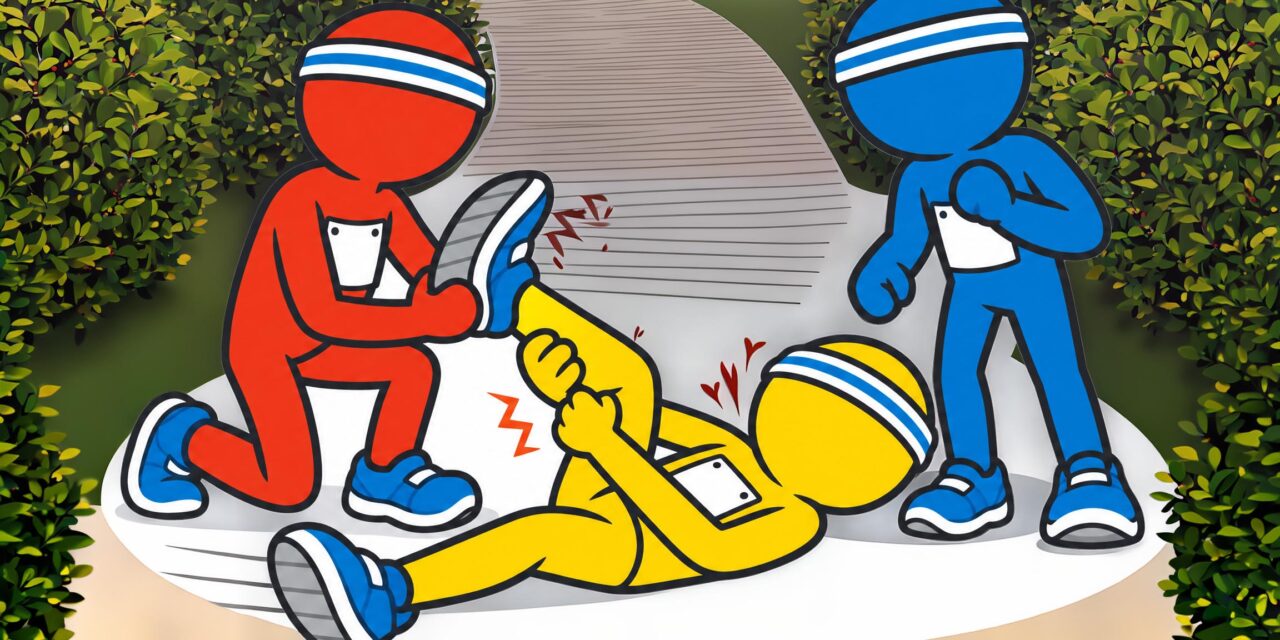
Most of us know the feeling. You are running happily when your calf suddenly tightens into a rock-hard lump. Or you stretch in bed, point your toes, and—BAM!—your toe or your calf seized up. So, what causes cramps?
One classic grandmother’s tale is that cramps happen because we didn’t eat enough salt. But in our local context where salt is almost always added liberally to our food and our Food jaga Authority has to come up with campaigns to urge us to eat less salt, that cannot surely be the case. Or is there some truth to it?
While many runners typically blamed dehydration or electrolyte depletion i.e lack of salt, modern sports science studies# suggest that cramps are usually caused by a combination of factors. In other words, your muscles may simply be telling you that you have asked a little too much of them
1. Neuromuscular Fatigue (Most Common Cause)
When muscles are pushed beyond their current endurance level or asked to maintain a pace they are not prepared for, the nervous system’s control of those muscles can become disrupted. The signals encouraging the muscle to contract may become overactive, while the signals that help it relax become less effective. The result can be a sudden, painful cramp.
The Usual Triggers: Going out way too fast at the start line (we’ve all been seduced by the adrenaline and the loud race music!), which forces your muscles into anaerobic panic mode early on. It also happens when you skip your training—specifically those crucial long runs.
Build up your endurance gradually and include appropriate long runs in your training. Practising at a pace close to your intended race pace can help your body get used to the duration and demands of the event.
2. Dehydration and Electrolyte Loss
Heavy sweating leads to a loss of fluids and key minerals like sodium, potassium, and magnesium.
Some runners seem to think they are a camel and can store water, skipping every water station to shave three seconds off their personal best. Bad idea. Electrolytes are essential for nerve impulses and muscle contractions. A significant fluid and sodium deficit increases nerve irritability, making muscles more prone to seizing up, especially in hot and humid conditions.
We looked at this previously in our story on Run Safe on Race Day when we talked about dehydration, heat exhaustion and heat stroke. Take a read if you have not done so.
3. Inadequate Warm-Up
Launching straight into a hard run with muscles that are not ready for the effort can increase the strain on them and bring on fatigue earlier. A proper warm-up helps prepare your muscles and nervous system for the work ahead.
Unfortunately, most people do not see the need for it. Let’s be honest: almost nobody wants to warm up when we’re packed like sardines in a humid start pen at 4:30 AM, already sweating buckets and wishing we could peel our skin off. But still – being hot is not the same as being properly warmed up.
A few minutes of dynamic movement warming up is important. We have covered the why and how of warming up in an earlier Running Shots story. Give it a read before your next race—preferably before you enter the start pen.
4. Inadequate Recovery or Fueling
Running low on glycogen (your muscles’ stored energy) or starting a race without recovering properly from previous workouts can leave your muscles more vulnerable to fatigue.
Some runners love squeezing in as many races as possible, sometimes with barely any recovery between them. Then there are those who go on a Runcation and spend the three days before the marathon walking 25,000 steps a day sightseeing, shopping, and climbing temple stairs—arriving at the start line with legs that are already completely cooked.
Enjoy the holiday, of course—but remember that sightseeing also counts as time on your feet. Give yourself enough rest and fuel properly before the race.
How to Prevent Cramps
A few sensible habits can reduce your risk of cramping before and during a run:
Before & During the Race
- Pace yourself sensibly. Stick to a realistic race or long-run pace—one you have practised during training. Resist the temptation to sprint off at the start just because everyone around you appears to be chasing a bus.
- Warm up dynamically. Spend 5–10 minutes doing movements such as leg swings, high knees, walking lunges and calf raises. These help prepare your muscles and nervous system for the run. Yes, even if you are already dripping with sweat in the start pen.
- Hydrate and replace electrolytes appropriately. Drink fluids regularly before and during long or hot runs, guided by your needs and conditions. For races lasting longer than about 60–75 minutes, an electrolyte drink or chew containing sodium may be useful, particularly if you are a heavy or salty sweater.
- Fuel properly. Have enough carbohydrates before a race and consider energy gels or chews during extended efforts. Your legs need fuel to keep going; positive thinking alone does not contain many calories.
What to Do If You Get a Cramp Mid-Race*
If a cramp strikes, do not try to outrun it. Your muscles have already made its feelings very clear. Stop and deal with it:
- Stop and Gently Stretch: Pause running immediately. Gently lengthen the cramped muscle and hold the stretch for 15–30 seconds until the muscle relaxes. Do not bounce or force it.
- Massage the Area: Lightly knead or rub the muscle to encourage blood flow and signal the nervous system to relax the spasm.
- Sip Electrolytes / Salt: Drink an electrolyte solution or take a small amount of salt/chew to help if sweat loss is a contributing factor.
- Ease Back into a Walk/Jog: Walk for a few minutes once the spasm subsides before attempting to jog gently. If the cramp continuously recurs, stop running to avoid muscle damage.
*Disclaimer: We can’t guarantee these emergency fixes will magically erase a mid-race cramp—the real secret is smart training so you never get one in the first place!
One last word:
If cramps are severe, frequent, unusual, or accompanied by symptoms such as marked weakness, swelling or feeling unwell, seek medical advice rather than assuming it is just another running nuisance.
References
- The Foundational Hypothesis (1997 & 2009):
- Schwellnus, M. P., Derman, E. W., & Noakes, T. D. (1997). Aetiology of skeletal muscle ‘cramps’ during exercise: a novel hypothesis. Journal of Sports Sciences, 15(3), 277–285.
- Schwellnus, M. P. (2009). Cause of exercise associated muscle cramps (EAMC)–altered neuromuscular control, dehydration or electrolyte depletion? British Journal of Sports Medicine, 43(6), 401–408.
- The Blood-Test Field Studies (2004 & 2011):
- Schwellnus, M. P., Nicol, J., Laubscher, R., & Noakes, T. D. (2004). Serum electrolyte concentrations and hydration status are not associated with exercise associated muscle cramping (EAMC) in distance runners.British Journal of Sports Medicine, 38(4), 488–492.
- Schwellnus, M. P., Drew, N., & Collins, M. (2011). Increased running speed and previous cramps rather than dehydration or serum sodium changes predict exercise-associated muscle cramping: a prospective cohort study in 210 Ironman triathletes. British Journal of Sports Medicine, 45(8), 650–656.
- The “Pickle Juice” Lab Proof (2010):
- Miller, K. C., Mack, G. W., Knight, K. L., Hopkins, J. T., Draper, D. O., Fields, P. J., & Hunter, I. (2010).Reflex inhibition of electrically induced muscle cramps in hypohydrated humans. Medicine & Science in Sports & Exercise, 42(5), 953–961.