
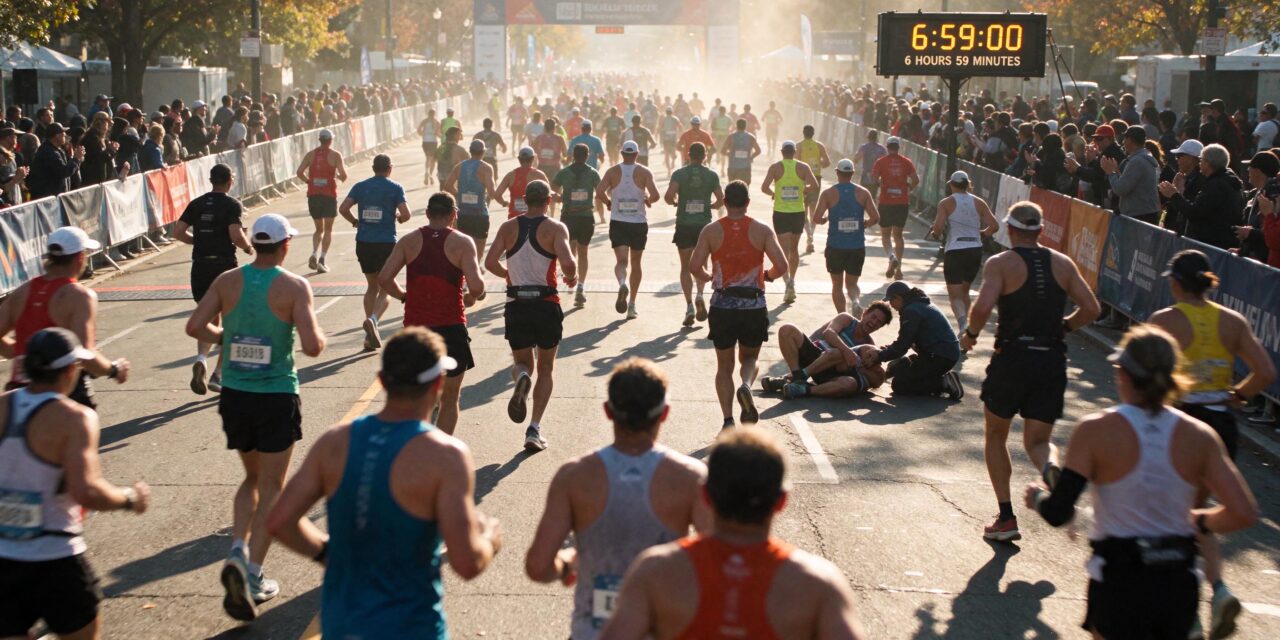
Only 500 metres to go. The full-marathon finish line is finally within sight. You glance at your watch: five minutes to the cut-off.
Ordinarily, 500 metres in five minutes should be manageable. But those #*^#_&% cramps! They keep returning, marching from the calves to the quads like a swarm of fire ants crawling up the legs. They started around the 20km mark and have refused to leave. You have wasted precious minutes stopping to stretch, and have been reduced to alternating between walking and brisk walking instead of running.
You round the corner. The finish line is now just 200 metres away, and the giant clock above it is ticking down. One minute to go. You summon whatever is left in your legs and try to run one last time. The cramps shoot through your legs and you stumble, collapsing in pain.
You look up in horror. The finish-line crew are preparing to close the course. No! No! No! You shout, your voice full of desperation and frustration.
“Oi, wake up! Time to get ready for the race!”
Your partner’s voice jolts you out of your nightmare. Thank goodness. It was only a dream.
Or was it?
The cut-off clock is ticking
The 2026 BYD Singapore International Marathon is just 2 weekends away. While most runners are busy thinking about their race-day outfits, breakfast plans and target finish times, there is one number they should not overlook: the cut-off time.
Many major road races impose a time limit. For example, the Tokyo Marathon has a seven-hour limit, the Standard Chartered Hong Kong Marathon has a six-hour limit, and the Kuala Lumpur Standard Chartered Marathon sets a seven-hour-15-minute limit for its full marathon. The 2026 BYD Singapore International Marathon gives full-marathon runners seven hours.
For the BYD Singapore International Marathon – these are the cut-off times for the various race categories:
- BYD Marathon (42.195km) & Crew Challenge: 7 hours
- adidas Half Marathon (21.0975km): 3 hours 45 minutes
- Standard Chartered 10km: 2 hours 30 minutes
- 5km Race: 1 hour 15 minutes [1, 2, 3]
Why do races have cut-off times?
There are two main reasons: roads have to reopen, and race resources cannot be stretched indefinitely.
- The roads cannot stay closed forever
Many big races use public roads. These roads have to be closed to traffic for runners’ safety, but they cannot remain closed all day or for extended periods of time. Organisers need to reopen them as soon as reasonably possible to restore normal traffic, public transport and access for residents and businesses.
After the runners have passed, crews also need time to remove barriers, portable toilets, signage and rubbish. In a busy place like Singapore, keeping roads closed for too long would cause a rather large headache for everyone — including people who have absolutely no interest in running 42.195km and will “kpkb”.
- Medical teams and volunteers need limits too
A race depends on medical personnel, ambulances, hydration stations, traffic marshals and volunteers. These resources are planned around a particular operating period and course schedule. If runners remain spread out along the route for hours beyond that window, it becomes harder to provide support safely and efficiently.
Cut-off times help organisers manage these resources and ensure that the event can be brought to a safe and orderly close.
Intermediate cut-offs: the checkpoints along the way
The finish-line cut-off is not the only deadline you need to worry about. Some races also have intermediate cut-off points along the route. These are checkpoints that runners must pass by specified times.
View this post on Instagram
What happens if you miss one? It depends on the race. Some organisers use sweeper buses to collect runners who can no longer continue on the course. Others may remove runners from the route, or direct them along an alternative route where this is permitted.
For the 2026 BYD Singapore International Marathon, the published regulations say that intermediate cut-off points may apply and that details will be provided in the Runner’s Information Guide. They also state that runners who fail to meet the applicable intermediate cut-offs may be removed from the course and classified as DNF.
What happens if you miss the cut-off?
If you do not complete your race within the applicable cut-off time, you will be classified as “Did Not Finish” (DNF). Under the 2026 BYD Singapore International Marathon regulations, participants classified as DNF will not receive an official finishing time or e-certificate, and will not be entitled to the applicable finisher’s medal or finisher’s T-shirt.
In other words, you may have covered 42km, battled the heat and humidity, survived the cramps — but if you miss the cut-off, you will not be recorded as an official finisher. That is a tough pill to swallow after months of training.
How do you stay ahead of the cut-off?
If this is your first marathon and you have spent the past six months training for it, the last thing you want is to be stopped just short of the finish line. Here are a few things to keep in mind.
- Know your numbers. To complete 42.195km within seven hours, you need an average pace of about 9 minutes 57 seconds per kilometre — roughly 6.03km per hour. You do not have to run at 9:57 min/km throughout the race. You can run faster on some sections and walk on others, provided your overall time and any intermediate cut-off requirements are met. This average includes the time spent walking, stopping at drink stations and taking toilet breaks.
- Plan a sensible buffer. Do not aim to cross every checkpoint with only seconds to spare. Crowds, congestion, toilet queues, cramps and the Singapore heat can all eat into your time.
- Use halfway as a reality check. Reaching 21.1km in around 3 hours 30 minutes is a useful even-pace reference for a seven-hour finish. But it leaves no spare time at all. If you can reach halfway a little earlier without overexerting yourself, you will have more breathing room for the second half.
- Do not try to win the race in the first 10km. Starting too fast can leave you paying for it later. Pace yourself, hydrate appropriately and follow the fuelling plan you practised during training.
- Read the Runner’s Information Guide. Check the official intermediate cut-off points, timings, road arrangements and instructions. The overall seven-hour limit is not the whole story.
Happy racing — and mind the two Cs: Cramps and Cut-Off!