

You’re happily cruising along on your morning run when suddenly…
PPRRRRAAAPPP!!
A loud fart louder than the cockerel crowning away escapes.
You’d like to think it’s your body’s turbo kicking in, but your running kakis beside you immediately go, “Eeeeee!” and suddenly discover sprinting speed they didn’t know they posses as they dash away from the toxic cloud.
Sound familiar?
Let’s be honest. Every runner has experienced this—either as the unfortunate offender or the innocent victim caught in the blast zone.
The worst part? You already visited the toilet before heading out. You did your duty. You emptied whatever could be emptied. Yet somehow, halfway through your run, your backside decides it has one more announcement to make.
Sometimes it’s just one dramatic trumpet blast.
Other times… it’s a rapid-fire machine gun sequence that would make your platoon commander panicked during the annual live firing..
So… what on earth is going on?
First Things First – Relax!
There’s absolutely no need to panic.
Farting while running—often called Runner’s Flatulence—is incredibly common. You’re definitely not alone. In fact, if everyone wore thought bubbles while running, you’d probably discover the person beside you is desperately hoping they don’t become the next sound blaster.
Here’s why running turns some of us into mobile wind instruments—and what you can do about it.
Why Running Makes You Fart
Running creates the perfect storm for trapped gas to make a grand escape.
The Paint Shaker Effect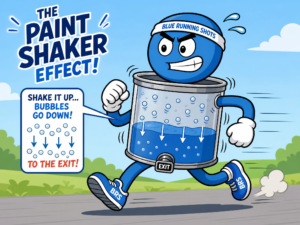
Think of your digestive system as a half-filled paint can.
Every stride shakes everything inside. Running’s constant up-and-down movement literally jiggles trapped gas down through your intestines much faster than if you were sitting on the sofa watching Netflix.
The gas was already there.
Running simply moves it faster to the nearest exit.
Blood Goes to Your Legs, Not Your Stomach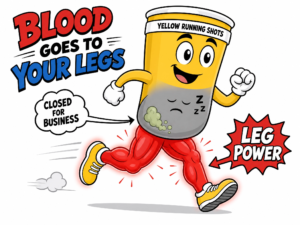
When you run, your body wisely decides that your leg muscles are more important than digesting breakfast.
Blood is diverted away from your digestive system towards your working muscles. Digestion slows down, food hangs around longer, and gas gets a chance to build up.
And the gas build up has to be purged from time to time…
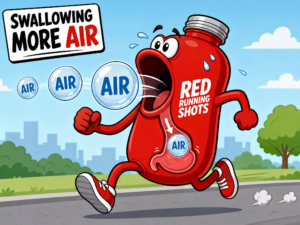
You’re Swallowing More Air
During harder runs, you naturally breathe faster and deeper. If you’re chatting, gulping water, or gasping like a goldfish, you’re also swallowing more air.
Unfortunately, what goes in… eventually has to come out.
One way…Or another.
Your Dinner decides to join the Party
Certain foods are famous for producing gas.
The usual suspects include:
- Beans and lentils
- Broccoli, cabbage and cauliflower
- Onions and garlic
- Dairy products (especially if you’re lactose intolerant)
- Artificial sweeteners
- Carbonated drinks
- High-fibre cereals
That healthy dinner you proudly ate the night before?
It might just become tomorrow morning’s surround-sound soundtrack on your playlist..
Gels, Chews and Sports Drinks
Many sports nutrition products contain sugars such as fructose, sorbitol and maltitol.
These ingredients can ferment in your intestines, producing even more gas—especially during long runs and marathons.
The energy may help your legs but as for your running buddies next to you
……maybe not so much.
How to Reduce the Gas Attack
The good news? A few simple adjustments can dramatically reduce your chances of becoming a human foghorn.
1. Be Smart About Pre-Run Food
What you eat the night before—and two to four hours before your run—makes a huge difference.
Try cutting back on:
- High-fibre foods
- Beans and lentils
- Large servings of broccoli, cabbage and cauliflower
- Dairy if you’re lactose sensitive
- Artificial sweeteners
- Fizzy drinks
2. Sip—Don’t Chug
Instead of emptying half a bottle in one go, take small, regular sips.
Chugging water forces you to swallow lots of air, which eventually has to find a way out.
Avoid carbonated drinks before running too. They’re basically pre-loading your digestive system with extra ammunition.
3. Breathe Properly
Try diaphragmatic (belly) breathing instead of shallow chest breathing.
It not only improves running efficiency but also reduces the amount of air you swallow.
Your lungs will be happier.
So will everyone running behind you.
The Running Shots Take
Most runners obsess over pace, cadence, heart rate, and imings.
Yet one of the most common running issues is something far less glamorous.
Gas.
Or, in the worst-case scenario…
Code Brown.
The good news is that farting during a run is usually perfectly normal. It’s simply your digestive system doing what digestive systems do.
With a little trial and error around food, hydration and sports nutrition, most runners can reduce the problem significantly.
But if one does sneak out during your run…
Simply drift slightly to the side, apologise if necessary, and keep moving.
The runner behind can spend the next kilometre wondering whether that mysterious headwind came from fertiliser on the grass…
…or from the runner in front.
And if you get caught red-handed—or should we say, red-bottomed—just smile and own it.
After all, running is all about propulsion.
Some runners simply come with an extra source of thrust.🏃💨