
Time to plan for the next stage
Due to work commitments, Miles had to travel to Bangkok on Tuesday afternoon and back on Saturday morning. This caused a major disruption to his original 10km Novice Training program.
Miles quickly adjusted the scheduling by bringing forward the 1hr Cross Training to Friday, and push the weekend long run to Sunday. All 5 activities are still intact, albeit re-arranged to suit his travel plans.
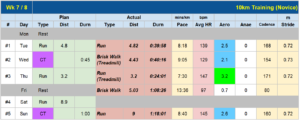
As his work week winds down on Friday evening, it was the perfect opportunity for Miles to take a 1 hour walk in Central Bangkok, exploring the vibrant mix of city life and bustling street activities. Stopping just after an hour to have dinner at a local diner.
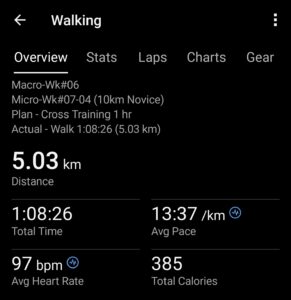
Macro Week #06 (10km Novice)
Micro Week #07, Session 4 –
Plan: Cross Training 1 hr
Actual: Walk 5.03 km (1:08:26 hr)
While flying back to Singapore on Saturday morning, Miles had a lot of time to think what their next steps should be. With one week left in the 10km Novice Training program, the logical progression should be the Half Marathon Novice Training program, with the Marathon as the eventual goal.
Looking at his recent progression, Miles noticed that his running pace is quite slow. And with a much higher mileage for the Half Marathon Novice Training program, his medium and long run will take much longer to complete.
An alternative is to do the 10km Intermediate Training program before embarking on the Half Marathon training program. Decisions… decisions…
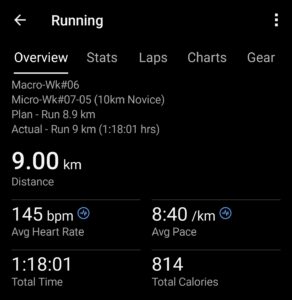
Micro Week #07, Session 5 –
Plan: Run 8.9 km
Actual: Run 9 km (1:18:01 hr)
Miles brought up both plans to Wade and Gallop during their weekend long run.
Option 1: 10km Intermediate Training Program
Option 2: Half Marathon Novice Training Program

Embarking on option 1 will means incorporating speedwork in their weekly routine. Whereas in option 2, they will still be doing easy run, but with much higher mileage.
Based on Hal Higdon’s 10km Intermediate training program, they will have to do 5 runs and 1 cross training session in a week. And among the 5 runs, there will be a speed session every Wednesday.
That’s quite a jump from their current 3 runs & 2 cross training session!!!
Speedwork is undeniably one of the staples in running. In order to run fast, you need to train fast. What will their decision be? What lies next after completing their 10km next week?
Stay tuned!!!
Key Reasons for Speed Work:
- Improved Running Economy: By training at higher intensities, your body learns to use oxygen more efficiently, allowing you to run faster with less energy expenditure.
- Increased Speed and Power: High-intensity intervals target fast-twitch muscle fibers, boosting your top-end speed and aerobic capacity.
- Better Cardiovascular Fitness: Speed training forces your body to work harder, which boosts your maximum oxygen consumption (VO2 max) and increases myoglobin production, accelerating oxygen transport to your muscles.
- Reduced Injury Risk: Speed work strengthens your muscles and improves the elasticity of tendons and ligaments, making them better prepared for harder efforts.
- Enhanced Mental Toughness: Regular speed sessions build mental resilience, teaching you to push through discomfort and maintain focus on your running form and pace.
- Improved Muscle Function: It forces your body to adapt to high loads and improved recruitment of muscle fibers.
Disclaimer
This is a work of fiction. If you think you recognize yourself in here, you’re probably mistaken… or you have a very unusual life. Names, characters, places, events, and incidents are either made up entirely or borrowed from the author’s overactive imagination. Any resemblance to actual persons, living or dead, is purely coincidental — and if it’s not, well, that’s just awkward.