If you’ve ever attended a running related talk or stood at the start line listening to people throw around terms like “pace,” “VO₂ max,” or “negative split,” you might have nodded along… while quietly thinking, “Huh, what they talking?”. Yah we don’t want to look stupid right?
Don’t worry—you’re not alone. Running has its own language, but once you understand the basics, everything from training to race day suddenly makes a lot more sense (and you won’t feel blur like sotong during post-run kopi chats).
Here’s a handy guide to common running terms—explained in plain English and Singlish — and why they actually matter to you as a runner.
1. Pace
What it means: How fast you run, usually in minutes per kilometre. 👉 “Bro, today my pace 5:30/km.”
Translation: Not slow, not fast—just nice to show off a bit but still can talk.
Why it matters: Pace is your main “speed control.” Knowing your pace helps you avoid going out too fast and suffering later.
👉 Go out too fast = early hero, later zero.
2. Stride Length
What it means: Not to be confused with steps and “strides workout”, a stride is in a nutshell, the distance covered when you take two steps, one with each foot.. This one too chim to explain in a few words so watch this video: https://youtu.be/zpqdCdpSU48?si=IC1hoGJ7iRl06tWs
Why it matters: A natural, efficient stride helps prevent injury and saves energy.
👉 Too long = overreaching like stepping over longkang
👉 Too short = like tiptoeing everywhere
3. Cadence
What it means: Cadence is the number of steps per minute.
Why it matters: A steady cadence improves efficiency and reduces impact on your joints.
👉 High cadence = “tap tap tap” like you rushing for last MRT.
👉 Low cadence = “relax lah, Sunday stroll.”
Cadence and Stride Length are like 2 twins. They go everywhere and do things together. Still don’t understand? Hear it from the expert:
4. VO₂ Max
What it means: The maximum amount of oxygen your body can use during exercise.
Why it matters: It’s a measure of your aerobic fitness—basically your engine size. The higher it is, the longer and faster you can run.
👉 High VO₂ max = Ferrari
👉 Low VO₂ max = old uncle bicycle, still can move but don’t rush
5. Heart Rate (HR)
What it means: How fast your heart is beating.
Why it matters: Helps you train at the right intensity instead of guessing.
👉 Easy run = can gossip
👉 High HR = cannot talk, only “eh… later… tell you…”
 6. Zone Training
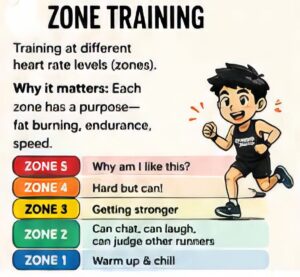
What it means: Also known as heart rate levels, zone training refers to training at different heart rate levels (zones).Generally there are 5 different running zones increasing in intensity for each different zone.
Why it matters: Each zone has a purpose—fat burning, endurance, speed.
👉 Zone 2 = chill run, can gossip
👉 Zone 5 = life flashing before your eyes
7. Negative Split
What it means: Running the second half of a race faster than the first half.
Why it matters: A smart pacing strategy that often leads to better race results.
👉 Means you smart.
👉 Also means first half you didn’t chiong like hero.
8. Bonking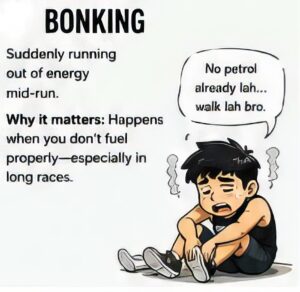
What it means: Suddenly running out of energy mid-run.
Why it matters: Happens when you don’t fuel properly—especially in long races.
👉 Body: “No petrol already.”
👉 Legs: “We strike.”
9. Carbo Loading
What it means: Eating more carbohydrates before a race.
Why it matters: Helps store energy so you don’t bonk halfway.
👉 Official reason: energy storage
👉 Real reason: excuse to whack pasta, rice, bubble tea
10. DOMS (Delayed Onset Muscle Soreness)
What it means: Muscle pain a day or two after running.
Why it matters: Normal part of training, especially after hard efforts or new workouts.
👉 Today strong, tomorrow walk like penguin
11. LSD (Long Slow Distance)
What it means: Long runs done at a comfortable pace.
Why it matters: Builds endurance—the foundation of all distance running.
👉 Keyword: slow… don’t ego run
12. PR / PB (Personal Record / Best)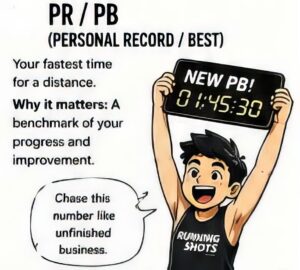
What it means: Your fastest time for a distance.
Why it matters: A benchmark of your progress and improvement.
👉 You will chase this number like unfinished business
13. Tapering
What it means: Reducing training before race day.
Why it matters: Allows your body to recover and perform at its best.
👉 Body resting
👉 Mind panicking: “Enough training or not???”
14. Interval Training
What it means: Alternating between fast running and recovery.
Why it matters: Improves speed and cardiovascular fitness.
👉 Run fast → regret → recover → repeat
15. Easy Run
What it means: A relaxed, comfortable run.
Why it matters: Essential for recovery and building mileage without burnout.
👉 If it doesn’t feel easy, you’re doing it wrong
16. Tempo Run
What it means: A sustained, comfortably hard effort.
Why it matters: Improves your ability to maintain faster paces for longer.
👉 Not dying, but also not enjoying life
17. Runner’s High
What it means: A feel-good sensation during or after running.
Why it matters: Helps with mental well-being and keeps you coming back.
👉 Rare… but when it happens, wah shiok
18. Chafing
What it means: Skin irritation from friction from your attire.
Why it matters: Can ruin an otherwise good run or race.
👉 The real enemy of runners. Can destroy your race faster than bad pacing
19. DNS / DNF
What it means: Did Not Start / Did Not Finish.
Why it matters: Reminds us that rest, recovery, and knowing your limits are part of the journey.
👉 DNS = alarm didn’t wake you
👉 DNF = body said “today not the day bro”
Sometimes stopping is smarter than suffering
20. Gun Time vs Chip Time
What it means:
- Gun Time: from race start horn
- Chip Time: from when you cross the start line
Why it matters: Chip time is your actual performance—especially important in big races.
👉 Good news for back-of-pack runners 😄
🧠 Why Knowing These Terms Actually Helps
Understanding these terms isn’t just for sounding chim during conversations—it helps you train smarter, race better, and avoid unnecessary injuries.
When you know your pace, you won’t burn out early.
When you understand heart rate and zones, you stop guessing your effort.
When you respect easy runs and LSD, you build a stronger foundation.
And when you learn things like fueling and pacing, you avoid painful lessons like bonking halfway through a race.
At the end of the day, running is simple—but improving at it is where knowledge makes all the difference.
💬 So next time your running kakis start talking about cadence, tempo, or negative splits—you won’t just nod… you can join in, steady one.