We runners hear a lot of advice. Some of it comes from coaches and sports scientists. Some of it comes from running buddies. And some of it comes from family. relatives and friends who have never run farther than the distance from the bus stop to the bus — but are nevertheless absolutely certain that running is bad for you.
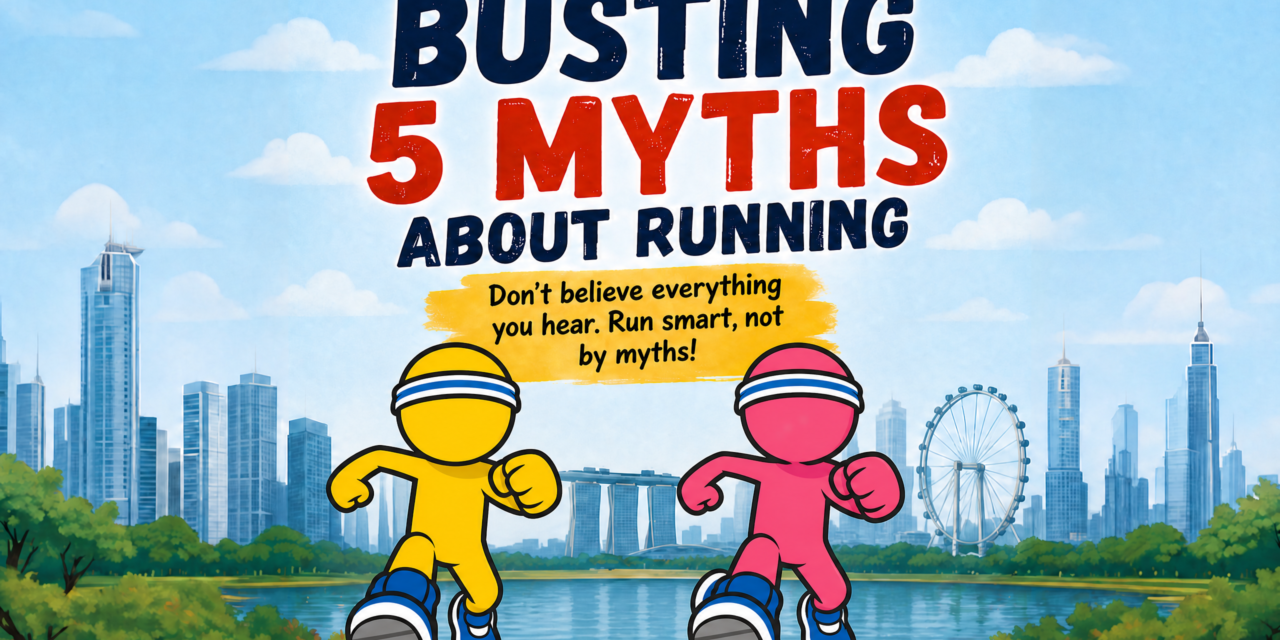
So let’s look at five of the most common running myths that has been floating around for the longest time.
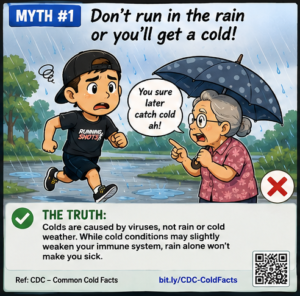 Myth 1: “Don’t run in the rain or you’ll get a cold!”
Many of us can still hear our parents saying this. But rain itself does not give you a cold. According to the U.S. Centers for Disease Control and Prevention (CDC), the common cold is a viral infection caused by respiratory viruses. You can catch a cold at any time of year; getting wet is not, by itself, the cause.
Rain can make a run miserable. It does not manufacture viruses. [1]
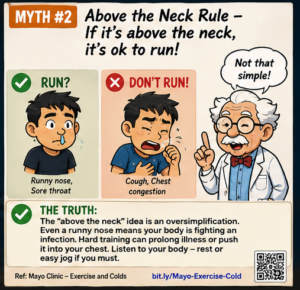 Myth 2: The “Above-the-Neck Rule” means you can always run when you’re sick
This popular rule says that if your symptoms are above the neck—such as a runny nose, sneezing or a mild sore throat—you can run, while symptoms below the neck mean you should rest. This is a big oversimplification.
The thing is, even with a simple runny nose or mild sore throat, your body uses extra energy to fight off the infection. Pushing yourself through a hard run diverts that recovery energy, which can drag out your illness or cause upper-body symptoms to move into your chest. Your immune system and your muscles fight for the same energy resources during a work-out.
If you must really run while nursing a cough or flu or even headache, switch to a slow walk or light easy jog instead of a tempo or long-distance run to avoid stressing the body further.
Mayo Clinic guidance says mild-to-moderate exercise may be reasonable when symptoms are limited to the upper respiratory tract and there is no fever. But the advice is to reduce the intensity and duration—for example, walk instead of doing a hard workout. Exercise should be avoided with fever, significant fatigue, widespread muscle aches, chest congestion, a hacking cough or other symptoms that suggest a more substantial illness. And if you have a contagious respiratory infection, running in a group is obviously not the time to practise your personal-best social distancing.[2]
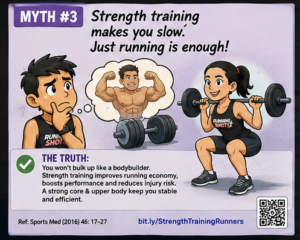 Myth 3: Strength training makes runners slow and bulky
The classic argument goes like this: strength training builds muscle, muscle adds weight, and extra weight makes you slower.
Research suggests the opposite can happen. Systematic reviews and meta-analyses have found that resistance and strength training can improve running economy and, in many cases, running performance. Importantly, studies in trained runners have not generally found that appropriate strength training automatically produces unwanted increases in body mass.
That does not mean runners need to become bodybuilding champions. Strength work should complement running, not replace it. For a distance runner, sensible resistance training can help develop the strength and power needed to run efficiently.
Done sensibly, strength training can make you a more efficient runner—not a slower one. [3–5]
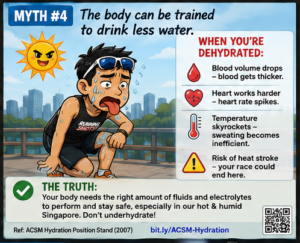 Myth 4: You can train your body to need less water so you don’t have to stop during races
This one deserves a big red flag, particularly in hot and humid Singapore. Deliberately trying to “train” yourself to drink as little as possible just to avoid water stations is not a clever shortcut to a PB.
Dehydration can increase cardiovascular and thermoregulatory strain and impair endurance performance, with the effects becoming more pronounced in the heat. Consensus guidance recommends beginning exercise adequately hydrated and minimising excessive dehydration during exercise.
In Singapore’s heat and humidity, practise your hydration strategy during training rather than experimenting with it for the first time on race morning.
Don’t deliberately dehydrate yourself for a PB; aim for enough fluid, but avoid overdrinking too. [6–8]
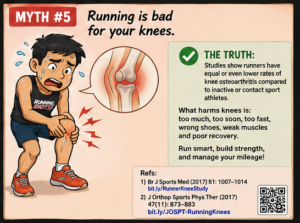 Myth 5: Running is bad for your knees
And finally, the mother of all running myths: “Running will destroy your knees.” It has been repeated so often that it has achieved the status of family folklore.
The research does not support the idea that recreational running inevitably wrecks the knees. A 2017 systematic review and meta-analysis published in the Journal of Orthopaedic & Sports Physical Therapy found that recreational runners had a lower occurrence of hip and knee osteoarthritis than sedentary controls in the studies analysed. Another systematic review found no clear evidence that running is associated with the development of knee osteoarthritis, although the authors noted that the available evidence was mixed and that more high-quality research is needed.
What damages knees isn’t running itself. It’s too much, too soon, too fast. Increasing volume too quickly, running workouts too hard, inappropriate shoes, lack of strength work: those are the real culprits. [9–10]
The Bottom Line
Running is full of myths and “folklores”. Some of it has a grain of truth; some of it belongs in the same category as “don’t swim for 30 minutes after eating”. The best approach is to question advice, look for evidence and—when in doubt, especially when illness or injury is involved—ask an appropriately qualified healthcare professional.
And if your grandmother still insists that running in the rain will give you a cold, you can disagree politely. Just don’t regret not being served the bowl of green bean soup she has on the stove.
References
[1] Centers for Disease Control and Prevention (CDC). “About Common Cold.” Updated February 19, 2026. https://www.cdc.gov/common-cold/about/index.html
[2] Mayo Clinic. “Exercise and illness: Work out with a cold?” Updated November 18, 2023. https://www.mayoclinic.org/healthy-lifestyle/fitness/expert-answers/exercise/faq-20058494
[3] Balsalobre-Fernández C, Santos-Concejero J, Grivas GV. Effects of Strength Training on Running Economy in Highly Trained Runners: A Systematic Review With Meta-Analysis of Controlled Trials. Journal of Strength and Conditioning Research. 2016. https://pubmed.ncbi.nlm.nih.gov/26694507/
[4] Blagrove RC, Howatson G, Hayes PR. Effects of Strength Training on the Physiological Determinants of Middle- and Long-Distance Running Performance: A Systematic Review. Sports Medicine. 2018. https://pubmed.ncbi.nlm.nih.gov/29249083/
[5] Moran J et al. Effect of Strength Training Programs in Middle- and Long-Distance Runners’ Economy at Different Running Speeds: A Systematic Review with Meta-analysis. 2024. https://pubmed.ncbi.nlm.nih.gov/38165636/
[6] American College of Sports Medicine. Exercise and Fluid Replacement. Medicine & Science in Sports & Exercise. 2007. https://pubmed.ncbi.nlm.nih.gov/17277604/
[7] Racinais S et al. Consensus Recommendations on Training and Competing in the Heat. Scandinavian Journal of Medicine & Science in Sports. 2015. https://pubmed.ncbi.nlm.nih.gov/25943653/
[8] Armstrong LE. Rehydration during Endurance Exercise: Challenges, Research, Options, Methods. Nutrients. 2021. https://pubmed.ncbi.nlm.nih.gov/33803421/
[9] Alentorn-Geli E et al. The Association of Recreational and Competitive Running With Hip and Knee Osteoarthritis: A Systematic Review and Meta-analysis. Journal of Orthopaedic & Sports Physical Therapy. 2017. https://pubmed.ncbi.nlm.nih.gov/28504066/
[10] Timmins KA et al. Running and Knee Osteoarthritis: A Systematic Review and Meta-analysis. American Journal of Sports Medicine. 2017. https://pubmed.ncbi.nlm.nih.gov/27519678/