

Struggling to complete the long run…..
Time for Miles and the buddies to go for their long run in their Week 5 program.
They decided to do their long run early to avoid the heat from the sun. However, Miles still feels the struggle in the second half of the run. Not forgetting that the re-adjustment in this week’s training schedule meant Miles had to train on 4 consecutive days.
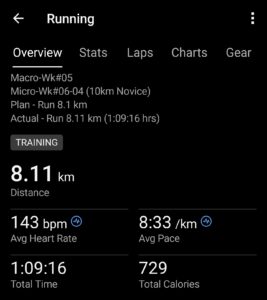
Though they managed to complete their 8.1km run at average HR of 143 bpm, the pace has slowed considerably to 8:33 mins/km. Initially, Miles had target to do his long run at around 8 mins/km pace. As what Miles used to say “The alcohol is good, but the flesh is rotten”
(“The spirit is willing, but the flesh is weak”)
Macro Week #05 (10km Novice)
Micro Week #06, Session 4 –
Plan: Run 8.1 km
Actual: Run 8.11 km (1:09:16 hr)
“Did I rest sufficiently?”
“Did I over stretch myself during the weekday runs?”
“Am I properly hydrated?”
Thoughts that went through Miles’ head as he slowed down his pace during the second half of his long run.
“Or perhaps, I’m just totally unfit?”… doubts started to manifest in Miles, and he now question himself if he will be able to achieve his first 10km completion milestone.
Micro Week #06, Session 5 (Part 1) –
Plan: Cross-Training 1 hr
Actual: Brisk Walk 35:15 mins (3.48 km)
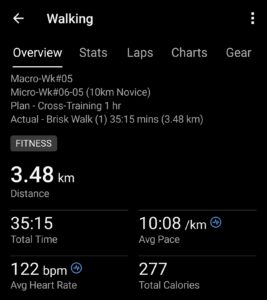
For the second consecutive Sunday, Miles has decided to break the 1 hr cross training into 2 sessions.
No rules to say the cross training has to be consecutive 1 hr, nor does it mean you can’t do different cross training as well. But for the time being, it will remain as walking for Miles.
Running regularly puts a lot of stress on the same joints and muscle groups. The idea of cross training after a long run helps keep us active while giving overworked areas – like your knees, ankles and hips – a chance to recover.
Micro Week #06, Session 5 (Part 2) –
Plan: Cross-Training 1 hr
Actual: Walk 25:02 mins (1.84 km)
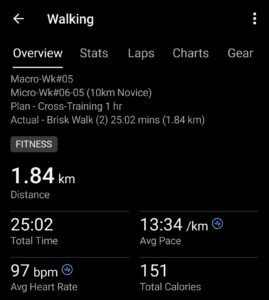
As with the previous week, Miles split the 1hr walk into 35mins in the morning and 25mins in the afternoon. It was a good way to recover from the Saturday long run and still let the legs muscle have a little light workout.

Taking a look at this week’s overall result, pace has generally slowed down. The only outlier was the Thursday overseas 3.2 km run on the treadmill.
Normally, Miles would tend to run faster for shorter distances and slower for longer distances. It is also good practice to increase only 1 dimension over the previous week. E.g. if you increase distance, don’t increase pace. If you increase pace, don’t increase distance etc.
2 more weeks to go before their 10 km target! How will Miles and his buddies fare in the coming two weeks? Stay tuned!!!
Common Reasons for 2nd Half Struggle:
- “Bonking” (Glycogen Depletion): Your body has used up its stored carbohydrates, leading to a sudden loss of energy and intense mental/physical fatigue.
- Cumulative Fatigue: Training in a high-milesge block means you are starting long runs already tired from previous workouts.
- Pacing Errors: Starting too fast, even by a small margin, causes you to overwork early on, making the later miles exceptionally difficult.
- Inadequate Fueling/Hydration: Failing to consume enough calories (gels/carbs) or fluids during the first half leads to a crash later.
- Reduced Muscle Tension: As muscles tire, they lose their “spring”, resulting in a sluggish feeling.
How to Make it Easier:
- Slow Down Early: Run the first half slower than you think you need to.
- Fuel Early and Often: Start taking in carbs/gels within the first 30-45mins, not just when you feel tired.
- Practice Strategy: Use long runs to test your race-day fueling and pace.
- Prioritize Recovery: Ensure you are getting enough sleep and recovery days, as hard training means being in a constant state of fatigue.
If the struggle is extreme, it may indicate improper eating habits or inadequate overall training volume.
Disclaimer
This is a work of fiction. If you think you recognize yourself in here, you’re probably mistaken… or you have a very unusual life. Names, characters, places, events, and incidents are either made up entirely or borrowed from the author’s overactive imagination. Any resemblance to actual persons, living or dead, is purely coincidental — and if it’s not, well, that’s just awkward.