
Walking to Recover…..
Time for Miles and the buddies to go for their long run in their Week 5 program.
As Miles did his 3.2km run the day before instead of resting due to work commitments, he’s not sure if the body will be conditioned for the long run.
They decided to do their long run early to avoid the heat from the sun. True enough, Miles started to feel the fatigue and had to struggle to complete the second half of the run.
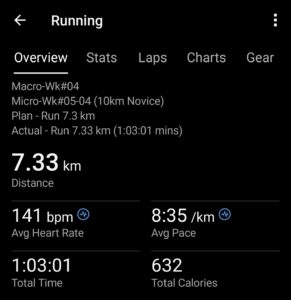
Though they managed to complete their 7.33km run at average HR of 141 bpm. But the pace has slowed considerably to 8:35 mins/km. (8:03 mins/km in the previous week’s 6.4km run)
Macro Week #04 (10km Novice)
Micro Week #05, Session 4 –
Plan: Run 7.3 km
Actual: Run 7.33 km (1:03:01 hr)
“Did the run on Friday caused the tiredness?”
“Did I over stretch myself during the runs?”
“Did I start too fast in the first half of the run?”
Thoughts that went through Miles’ head as he slowed down his pace during the second half of his long run.
“Or perhaps, I’m just totally unfit?”… doubts started to manifest in Miles, and he now question himself if he will be able to achieve his first 10km completion milestone.
Micro Week #05, Session 5 (Part 1) –
Plan: Cross-Training 1 hr
Actual: Brisk Walk 36:01 mins (3.11 km)
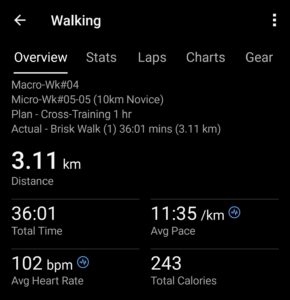
The Sunday cross training session has now been increased to 1hr.
As Miles still feels the fatigue over the Saturday run, he decided to break the 1hr cross training into 2 parts. It is perfectly fine to break it into more than one session.
Running regularly puts a lot of stress on the same joints and muscle groups. The idea of cross training after a long run helps keep us active while giving overworked areas – like your knees, ankles and hips – a chance to recover.
Micro Week #05, Session 5 (Part 2) –
Plan: Cross-Training 1 hr
Actual: Brisk Walk 24:01 mins (1.79 km)
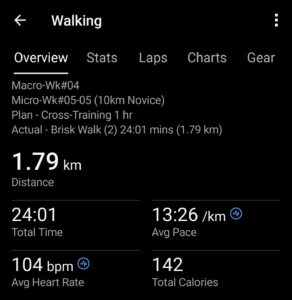
Breaking the 1hr walk into 36mins in the morning and 24mins in the afternoon serves as an excellent form of active recovery for Miles, helping to reduce muscle stiffness and soreness (DOMS) by increasing blood flow, which brings oxygen to tired muscles and removes waste products. This allows for recovery without the high impact on joints.
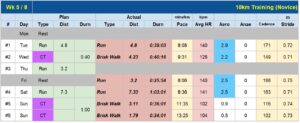
Miles observed that his average HR and pace has been consistent so far, except for the Saturday long run where his pace drops to 8:36mins/km
Consistency in running is important. But so is rest and recovery!
The Sunday cross training walk was a welcome relief for Miles. Sometimes a slow easy walk is better than complete rest and slouching on his sofa.
Benefits of Walking After a Long Run:
- Active Recovery: Improves blood flow to help muscles recover faster than complete rest.
- Reduces Stiffness: Keeps legs loose and helps manage soreness.
- Low-Impact Movement: Promotes cardiovascular health (aerobic base) without adding stress to muscles, tendons, or joints.
- Mental Break: Provides a light exercise option that reduces mental fatigue compared to high-intensity training.
How to Incorporate Walking:
- Easy Pacing: Keep the pace comfortable to ensure it acts as recovery rather than a strenuous workout.
- Duration: A 30-minute walk is often recommended as a good way to “reset” the body.
- Alternative Activities: Combine walking with other low-impact activities like gentle cycling or swimming for added recovery benefits.
Disclaimer
This is a work of fiction. If you think you recognize yourself in here, you’re probably mistaken… or you have a very unusual life. Names, characters, places, events, and incidents are either made up entirely or borrowed from the author’s overactive imagination. Any resemblance to actual persons, living or dead, is purely coincidental — and if it’s not, well, that’s just awkward.