
Working out the Plan – Micro Plan
“Here’s the full detailed plan” Miles explained “But take note that it may be subjected to changes along the way.”
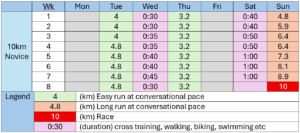
First micro plan is to complete a 10km without any time target. We do easy run to get our body back in shape with mainly aerobics training.
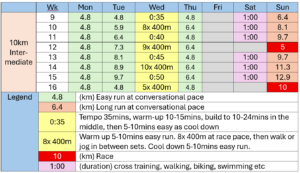
Once we have an idea what time we take to complete our 10km, we will move on to the next micro training – 10km Intermediate that includes speedwork. From 5 days a week, we now move to 6 days a week, leaving at least 1 day of full rest on Friday.
Once we decide on the target time to complete our next 10km, we will know what pace we need to run on our speedwork every Wednesday.
Tempo run with 10-15mins warm up, then gradually increase pace to race pace and cool down in the last 5-10mins. For example, if we target a 70mins 10km, our race pace will be 7mins/km.
Similarly, on alternate Wednesday, we will be running 400m repeats. At 7mins/km race pace, our 400m repeats should be run at 4:40mins, jogging or walking in between sets. Idea is not to get our heart rate down too low before we start our next repeat.
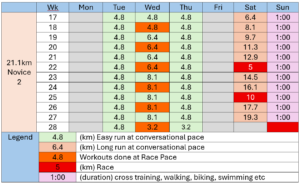
Once we adjusted our body to some speedwork, we will then move on to our next target. 21km Novice 2 training program. This program moves back to 5 days a week, but with 4 runs and only 1 cross training day.
Some of the runs (highlighted in red) will be done at Race Pace throughout (Different from Tempo run, where we gradually increase pace). Of course, we will still require a warm up and cool down before and after in order to reduce the risk of injury.
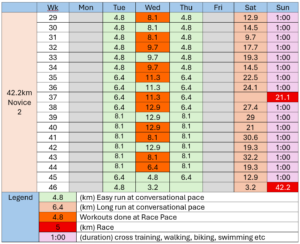
Last but not least, if we survive until this stage, we can now safely move on to the 42km Novice 2 training program. This looks very similar to our 21km Novice 2 training program, except that the distances have increased, and it is now an 18 weeks program instead of 12 weeks.
Notice the gradual increase in long run distance, cumulating in our longest run of 32.2km in week 35. Thereafter we will go into the Tapering stage of the training program where we reduce overall mileage until our race day. This ensure we are well rested before the big day itself.
I’ve broken them down into 4 micro plans so that it looks more manageable. We can also adjust them as we progress. For example, we can consider adding a week or two of rest in between our micro plans if necessary.
As Miles explained the entire plan in detail, the rest listened intently, eyes gleaming in excitement, with an air of enthusiasm that they have not experience in a long time.
They now have a target to work towards, more importantly, they HAVE A PLAN!
Runners should consider incorporating brisk walking into their training:
- Cross-Training Benefits: Brisk walking offers a low impact alternative to running, allowing runners to give their joints a break while still maintaining cardiovascular fitness and muscle endurance.
- Active Recovery: After a long run or intense workout, brisk walking can promote blood flow to tired muscle and aid in the removal of metabolic waste products, aiding in recovery.
- Endurance Building: Long brisk walk can be valuable for building endurance, especially for novice runners or those transitioning to longer distances.
In summary, brisk walking can be a beneficial addition to a runner’s training routine, providing cross-training benefits, aiding recovery, and building endurance. It is a low-impact exercise that can be easily incorporated into a runner’s schedule.
Disclaimer
This is a work of fiction. If you think you recognize yourself in here, you’re probably mistaken… or you have a very unusual life. Names, characters, places, events, and incidents are either made up entirely or borrowed from the author’s overactive imagination. Any resemblance to actual persons, living or dead, is purely coincidental — and if it’s not, well, that’s just awkward.